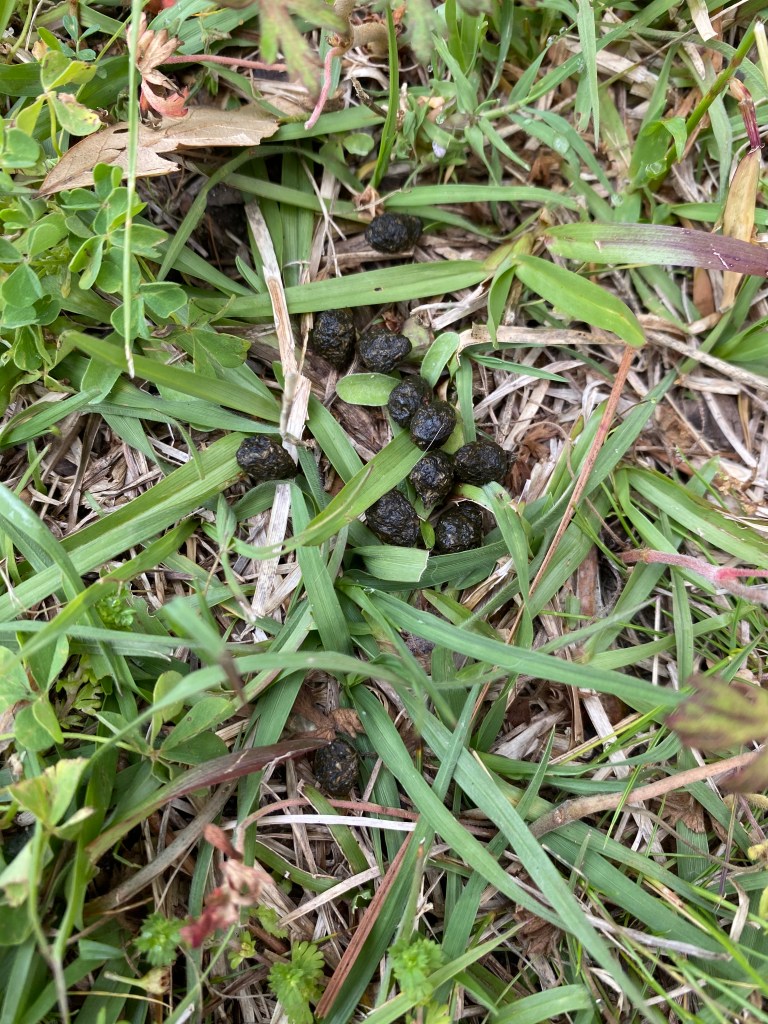
This probably isn’t the picture you wanted to see when you first opened this blog, but there is a reason for it.
My two daughters, both toddlers, ran out into the yard to play this morning. Their hope was to discover mud puddles from last night’s rain to jump and splash in, and pour over each others’ heads. That’s what toddlers do. As they ran towards the back fence line, they reached a spot, stopped, and screamed for me. My first instinct was a torpid snake. It’s cloudy and somewhat cool out, a snake could be stuck waiting for the sun to warm him up.
It was not a snake. Nor a lizard. Nor a dead animal.
It was bunny poop — apparently I’m raising budding zoologists who specialize in scatology.
We live in the suburbs, but our suburb is awfully close to the Great Dismal Swamp. So close to the swamp that it is not uncommon for black bears to wander into our neighborhoods. Our neighborhood sits along an on-ramp to an interstate and extends along a portion of it. There are considerable easements from both the state and the city on either side of the interstate. Those easement provide a corridor that acts like a highway of its own for all kinds of wildlife to go on their own sauntering adventures. Some of them have established new homes in the storm water mitigation pond behind my house. There is a family of rabbits that live in the tree line and in the pond area and there are squirrels that live in the trees along the tree line. The rabbits have brought at least one fox into the neighborhood — we won’t discuss the vagaries of nature at this point. I’m not sure if the fox lives here or just visits, I’ve only seem him a few times, and always just after sunset or just before sunrise. The rabbits and the squirrels usually wander around the yard shortly after sunrise looking for any scraps I’ve thrown out for them. Vegetable scraps, bread — and the leftover pancakes from breakfast this morning. It’s nice to see the squirrels and rabbits bound through the yard, sniffing as they go, looking for food. The scraps have also attracted crows who land in the yard, look around, pick up a slice of bread or a pancake, then fly off somewhere, whether to share or devour on their own, I do not know. It’s nice to sit at my desk, look out the window and watch them all — squirrels, rabbits, crows — scavenge the food I toss out.
All short lived, I guess. I’m planning to put in a raised garden and grow vegetables and herbs. I made sure to order one with a deer fence around it — yes, sometimes there are deer who will wander through the neighborhood, more frequently than the bears. I am looking to put a few Compots in the garden for composting my scraps. The advantage of Compots are they can be buried in the garden and meat, vegetables, oil — whatever — can be put into them for composting. They require no real attention other than to keep them replenished with scraps. The scraps will decompose, attract fly larvae and worms and will leach off into the garden providing nutrients for the soil. Unfortunately, as I place more scraps into the Compots and not into the yard, the return of the squirrels, rabbits, and crows will be short lived. That makes me sad. I enjoy their presence. Perhaps I should share the wealth of the scraps with them so I can continue to enjoy them scampering through the yard, eating, playing, and rejuvenating — all metaphors for the joy they bring me as I watch their natural exuberance.
So, what does this all have to do with bunny poop? Nothing? Everything? I tell my daughters, “everything poops”. It makes little never mind to them *what* there is to explore so long as there is *something* to explore. They looked at the bunny poop as though it were some sorcery, some inexplicable evidence of fairies or gnomes, and summoned me to see that which bewitched them. The eyes of children perceive and intuit more than the eyes of adults. “There are more things in heaven and earth, Horatio….” (1)
And therein lies the lesson of bunny poop: looking to see, not looking to look. As adults, we overlook so much beauty in our lives as we continue to chase whatever goal we have set for today, forgetting the simple joys of life — sunrises, sunsets, wildflowers, our children’s drawings, our children’s musings and play. Long ago Thoreau “lost a hound, a bay horse, and a turtledove” and is probably still on their trail. (2) We should all be like Thoreau and pursue them. It will only give more meaning to our otherwise stressed and stretched lives.
That was a really long way to say go look for bunny poop, you’ll be surprised what you find.
——————————————
(1) Shakespeare, William. Shakespeare: The Complete Collection. Hamlet; Act 1, Scene 5. Pandora’s Box. Kindle Edition.
(2) Thoreau, Henry David. Walden and Civil Disobedience (Illustrated) (p. 8). American Renaissance Books. Kindle Edition.
 Sauntering Photographer